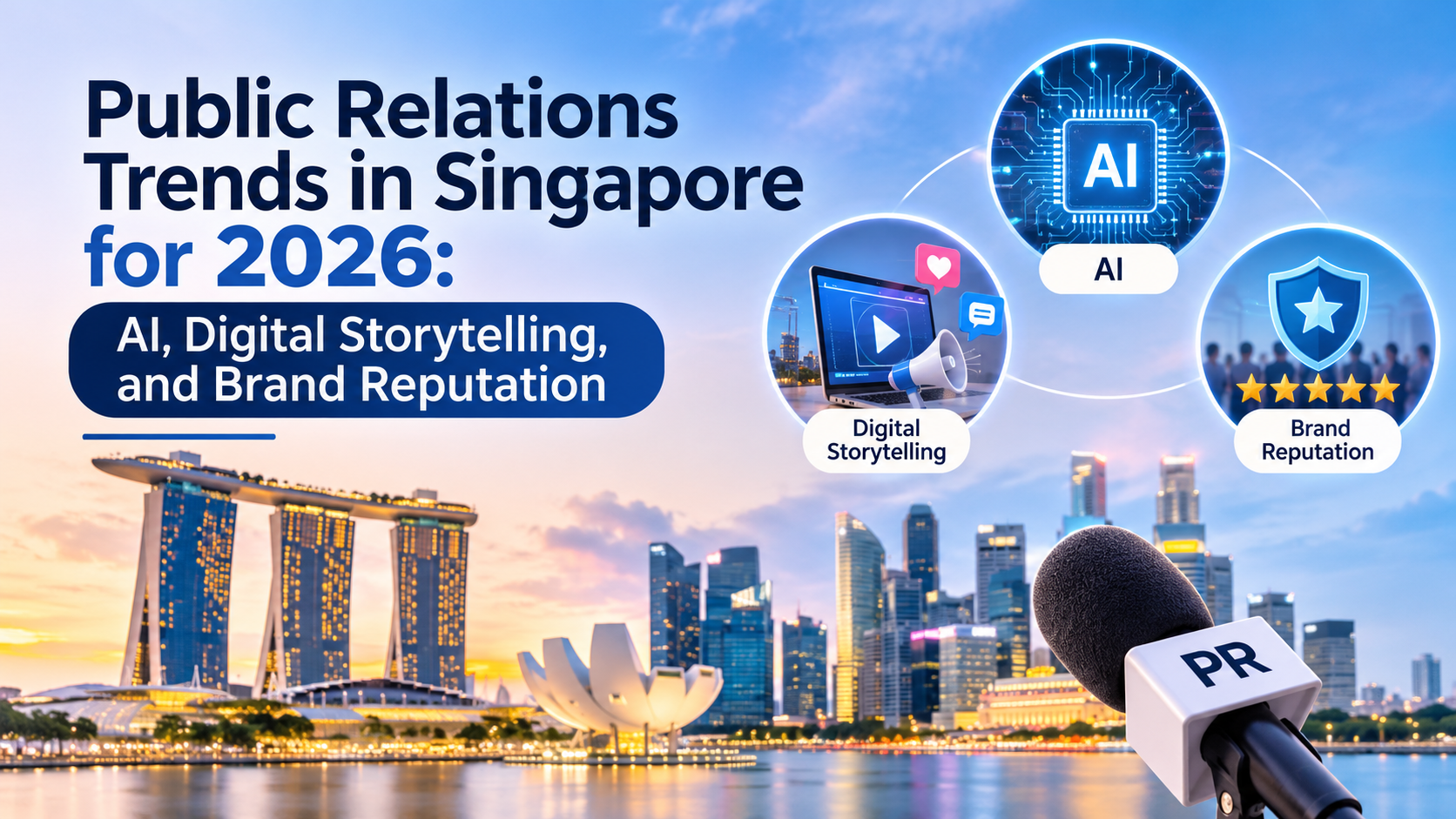
The biggest public relations trends in Singapore for 2026 are smarter use of AI, stronger digital storytelling, and closer care for brand reputation. A capable public relations agency in Singapore now has to handle all three together, and this is the part where many brands still struggle.
The wider industry feels this pressure as well, since 67% of global PR agencies forecast growth in 2026 even with economic and AI-related strains. That finding comes from the International Public Relations Network, which surveyed 22 countries, including Singapore, in its annual 2026 study.
So what do these shifts really look like in practice, and which ones should you act on first? Let us walk through each trend one at a time, so you can judge what matters for your own brand.
Key Takeaways
- AI is now a regular tool for drafting, research and monitoring, but people still decide the message, the tone and the final approval.
- Digital storytelling turns one piece of media coverage into several posts, videos and creator mentions that reach people where they already scroll.
- Brands need to prepare before any problem arises because rebuilding public trust is a much harder task than maintaining it.
- Singapore’s official guidance on generative AI, from IMDA and the AI Verify Foundation, gives PR teams a practical checklist for using AI responsibly.
What Are the Main Public Relations Trends in Singapore for 2026?
News, opinions and reviews now move quickly between media outlets and social platforms. Brands now have to speed up to match them.
That pace explains why PR work in 2026 looks different from a few years ago, and why one press release is rarely enough.
Which Three Trends Deserve Your Attention?
Most conversations about the year ahead come back to three connected ideas, and each one changes how brands plan their communication.
- AI-assisted PR workflows: teams use AI to speed up research, first drafts and coverage tracking while keeping human review firmly in place.
- Digital storytelling: brands tell their story through media, social platforms and creators together, instead of treating each channel as a separate task.
- Reputation and trust: audiences expect honesty, quick responses and consistent messages, and they notice quickly when a brand falls short.
These ideas overlap more than you might expect, so any Singapore PR company Singapore PR company worth hiring should explain how they fit together.
How Is AI Changing Public Relations in Singapore?
AI has become a regular part of PR work, and the real question is where it adds value and where it could quietly weaken trust.
Where Does AI Help PR Teams Most?
AI works best on the repetitive parts of the job, where speed matters more than personality.
- Research and monitoring: scanning large amounts of coverage and social conversation to spot what people are saying about a brand.
- First drafts: producing a rough press release or social caption that an experienced writer then edits, corrects and gives a proper voice.
- Audience insight: analysing data to uncover trends and preferences, so messages can be tailored to the people who will actually read them.
- Admin and organisation: sorting media lists, summarising long reports and preparing coverage updates in much less time than before.
Where Do People Still Lead?
Relationships with journalists, cultural sensitivity and good judgement under pressure still come from people, not software. A tool can suggest a pitch angle, but it cannot sit across from an editor and sense whether the timing feels right. That is why a Singapore PR company that uses AI well still keeps experienced professionals in charge of pitching, follow-up and final approval.
What Does Singapore’s Official Guidance Say About AI?
Singapore’s Infocomm Media Development Authority (IMDA) and the AI Verify Foundation released the Model AI Governance Framework for Generative AI on 30 May 2024. You can read the overview on the IMDA website, and the framework itself offers practical suggestions rather than a strict rulebook.
It lists nine dimensions that organisations should consider together, and the table below summarises them in simple terms for PR teams.
Source: Model AI Governance Framework for Generative AI, published by IMDA and the AI Verify Foundation.
| Dimension | What the framework covers | Why it matters for PR |
| Accountability | The right incentives for each player in the AI chain to be responsible to end-users | Agency and client agree who approves AI-assisted content |
| Data | Data quality, plus a pragmatic approach to contentious data such as personal data and copyright material | Keep confidential client details and copyrighted material out of AI tools |
| Trusted development and deployment | Transparency about baseline safety and hygiene measures, based on industry best practice | Choose tools from providers that explain how they work |
| Incident reporting | Timely notification, fixing and continuous improvement when AI systems go wrong | Have a plan ready if AI-assisted content contains an error |
| Testing and assurance | Third-party testing and common AI testing standards | Check outputs carefully before anything goes public |
| Security | Addressing the new threats that generative AI models create | Protect client data, accounts and campaign materials |
| Content provenance | Transparency about where content comes from | Be open when text or images are AI-generated |
| Safety and alignment R&D | Global cooperation among AI Safety Institutes to keep models aligned with human intention | Stay informed as the tools keep changing |
| AI for public good | Using AI for public benefit through wider access, public sector adoption and upskilling workers | Balance speed with responsibility to the community |
How Can PR Teams Apply This in Daily Work?
You do not need to memorise all nine dimensions to benefit from them, so start with three simple checks. Ask who approves AI-assisted content, what information goes into the tools, and how the final result is disclosed to the audience.
Why Does Digital Storytelling Matter So Much in Singapore PR?
Digital storytelling means telling one clear brand story across media coverage, social platforms and creator content, so people meet it in several places. Audiences rarely stay on one channel, so a story seen in an article, then an Instagram post, then a creator’s video feels far more real.
Our own approach to restaurants and retail starts with the senses, since customers experience a brand through sight, sound, smell, taste and touch. The job is then to pass that sensory picture on to the media, who share it with their readers.
How Does Media Coverage Become Social Content?
Digital public relations means taking the coverage a brand earns and extending it across social media and influencer channels. A feature in a food magazine, for example, can become a short video, a carousel post and a creator visit within the same fortnight. A PR agency in Singapore that plans for this from day one gets much more out of the coverage it wins.
Where Do Creators Fit Into the Story?
Creators can turn a first moment of interest into a real visit, especially for restaurants and shops, where a viewer immediately wonders where to go next. The smarter way to choose them is to start with your customers and then pick the voices those customers already trust. A public relations agency in Singapore can line up both, so the news article and the creator post support each other.
Planning your 2026 communication roadmap? Speak with our team about turning these trends into a clear, practical plan for your restaurant, retail or B2C brand.
How Are Brands Protecting Their Reputation in 2026?
Reputation grows slowly through steady, honest communication, yet it can wobble within hours when something goes wrong online. Many brands now treat reputation as a daily habit rather than a repair job after a crisis. A good PR agency in Singapore builds crisis planning into normal work, not into an emergency add-on.
Why Should You Prepare Before a Problem Appears?
Crisis management sits within the public and media relations work we offer, alongside strategy, press release writing, media pitching and follow-up.
- Agree on spokespeople in advance, so the right person answers media questions quickly, calmly and with the same facts every time.
- Prepare holding statements for likely situations, such as service complaints, product issues or negative reviews, so nobody starts from a blank page.
- Set a clear approval path so that messages reach the public fast without skipping important checks.
- Monitor conversations on news sites and social platforms, because early signals are far easier to handle than a full-blown storm.
These four habits can help PR teams respond more consistently when a brand faces a difficult situation.
How Do You Keep the Message Consistent?
A brand story only builds trust when the website, social pages, press materials and staff all say the same thing. PR agencies describe this as keeping the brand narrative consistent across platforms, which supports recognition and loyalty over time.
Why Should You Be Open About Using AI?
Being open about when you use AI protects the trust you have built with your audience over many months. IMDA’s framework highlights content provenance, which means transparency about where content comes from, as a useful signal for people reading or watching.
Staying Ahead of These PR Trends with a Public Relations Agency in Singapore
AI will keep improving, platforms will keep changing, and audiences will keep expecting honesty from the brands they follow. The brands that stay steady usually have a clear story, a responsible approach to AI and a plan for when things go wrong.
We works with retail, restaurant and B2C brands in exactly these areas, from media relations and digital PR to crisis management. If you want to explore how these trends apply to your brand, our team is happy to talk. Get in touch with Affluence PR today, and let us plan your 2026 story together.
Frequently Asked Questions
These are the questions readers raise most often about the trends above, and the answers go a little deeper than a quick yes or no.
What are the main public relations trends in Singapore in 2026?
The three trends most worth watching are AI-assisted workflows, digital storytelling across several channels, and proactive reputation management. Each one supports the others, because AI saves time on routine tasks, storytelling gives teams something worth sharing, and reputation work keeps the message trustworthy. A PR agency in Singapore usually weaves all three into a single plan instead of running them as separate projects.
How is AI used in PR, and is it safe to rely on it?
AI helps with research, monitoring, rough drafts and organising media lists, which frees people to focus on relationships and strategy. It stays safe when a person checks every fact, name and quote before publication, and when client data stays out of open tools. A PR agency in Singapore that follows IMDA’s framework will also agree on who approves content and disclose AI-generated material openly.
What is digital storytelling in PR?
Digital storytelling means sharing one brand narrative across media, social platforms and creator content, in formats suited to each channel. A restaurant opening, for instance, could appear as a press release, a short video, an Instagram carousel and a creator visit. Each piece points back to the same core message, so audiences recognise the brand wherever they meet it. Good storytelling also listens, since comments and shares show which parts of the story people truly care about.
Why does brand reputation matter in PR?
Reputation shapes whether people choose, recommend and forgive a brand, and PR is the discipline that influences it through earned media and consistent communication. PR manages the flow of information between an organisation and its customers, investors and the wider public. A strong reputation does not remove problems, but it gives audiences a reason to listen to your side first. That is why a PR agency in Singapore spends as much time preparing for problems as celebrating wins.
How are the best public relations companies in Singapore adapting to these trends?
The best public relations companies in Singapore use AI for routine tasks while keeping senior people on pitching and client advice. They also carry earned media onto social and creator channels, and they rehearse crisis responses before a real issue arrives. Many are becoming more open about AI use too, which matches the direction of Singapore’s official guidance.